Can changing what you eat if you’re depressed and in college improve your mood by 70%? I’m Dr. Drew Ramsey. I’m a nutritional psychiatrist and board certified psychiatrist. I’m interested in how changing what we eat can better improve our mental health and our brain health. And boy, we have a historic piece of research to talk about. This video is going help you understand more about whether ketogenic diets are actually impactful for depression. It’s going to help you with the latest research that just came out August 2025. And it’s going to help you if you have a college student or if you’re in college, think about some of the food choices you’re making and making sure that those are informed by research.
So what are we talking about? There is a study out of Ohio State University by Drew Decker and Jeff Volek. It is a great piece of research. It’s historic because it’s the first time anyone has ever tried to use a ketogenic diet, which is a diet that’s mostly fat. You’re going to get fewer than 50 grams of carbohydrates every day and your body is then going to move into ketosis.
How does this matter for mental health? Well, if you’ve been paying attention to metabolic psychiatry, this new trend along with nutritional psychiatry and how we think about mental health disorders, ketogenic diets use mainly fat and then they force the brain or our metabolism to start burning fats, making what are called ketones. Ketones are the short three carbon fuels that are the products of fats. When our brain needs extra fuel and we need to use fats and we don’t have enough carbs, we make ketones. You’ve probably heard of one beta hydroxybutyrate. If you’ve seen people who’ve been on the keto diet, the Atkin diets, and they’re using urine strips, they’re testing beta hydroxybutyrate in their urine. It is the main ketone that we make. Ketogenic diets have been used for a long time in neurology to treat pediatric epilepsy. We’ve got another video up about Shebani Sethi’s trial from the Metabolic Psychiatry Group in Stanford, where they used a ketogenic diet in severe mental illness patients with bipolar disorder and schizophrenia and they had great outcomes, both in terms of mental health, but also in terms of metabolic health of these patients. They lost weight, they lost fat mass.
So what about college students and what does this trial show? 24 patients or students with depression who were already in some counseling and getting medication, were given a ketogenic diet. Now, this is not your grandfather’s ketogenic diet. It’s called the well-formulated ketogenic diet. So we’re going to emphasize more healthy fats, instead of just bacon and jerky, they’re going to get some jerky, but also a lot of tin fish like sardines and anchovies. They’re going to be encouraged to eat crunchy vegetables. This study employed a food hamper, which is in a lot of these nutritional psychiatry studies. For example, there’s a study in Australia for depression using a Mediterranean diet for college depression. They give a food hamper and this is to encourage students to eat these foods, but also some of these things like tinned fish might not exactly be in the repertoire of lot of college students.
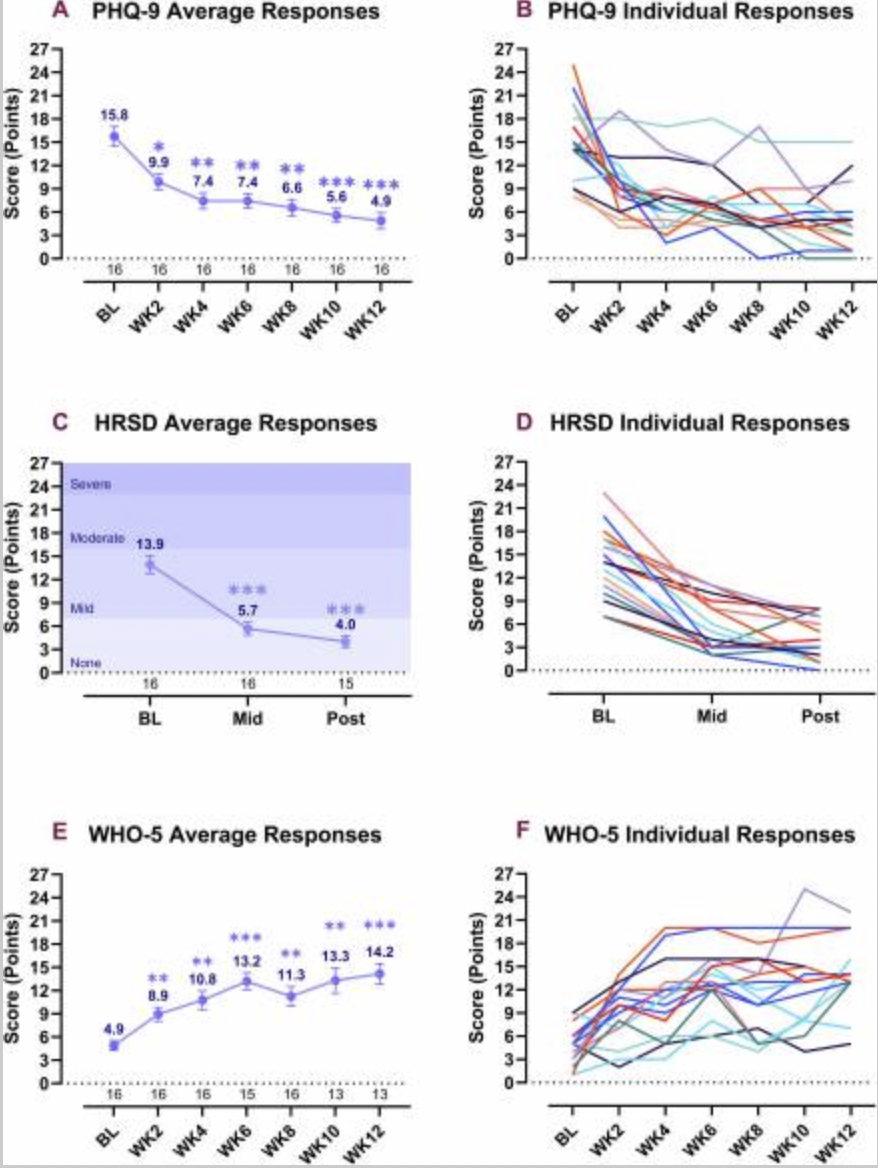
The intervention also gives a lot of encouragement. The students had an app, they had access to coaches, and of course they got a lot of lab testing and then also testing of their mental health using two of our most common mental health rating scales, the PHQ-9 and the Hamilton Depression Rating Scale. So that bold claim that I made at the beginning, it was absolutely true. If you look in the data, after 10 to 12 weeks on the ketogenic diet, you can see the patient’s mood symptoms improved by 70%, 69 % on a self-reporting scale, the PHQ-9, and then on a clinician rating scale, the Hamilton Depression Rating Scale, there was also a 71 % improvement.
There were other exciting results from the trial. First of all, college students were able to maintain a ketogenic diet. That’s a really important finding which doesn’t really exist that much in the literature. They had a daily measurement of BHB and 73% of the time they were in ketosis. So this is a great job. That was really impressive. And you can tell that that means they got a lot of good counseling.
Other findings… BDNF, our favorite molecule. This is what I call the molecule of hope in all of my books. It’s the main molecule that triggers what’s called neuroplasticity. This is brain growth and repair, literally growing new brain cells. How exciting is that? So BDNF went up 32 % in this trial- a really exciting finding. Also people lost weight, 6.2% loss in body mass. It was about 13% loss in total body weight. So that was really exciting. Another major finding is leptin, which is one of the major molecules in our body uses to signal satiety and energy balance, decreased by 52%. These are all really important biological markers that showed, one, the students were taking this diet very seriously and adhering to it and two, that we got great results. The researchers showed that you’ve got decreased inflammation and you get an increase with the factors that seem to signal more brain growth.
One quick caveat is this was a pilot trial. This isn’t a double blind trial, it’s not randomized. So we don’t want to take these findings and then extend them to say that everybody with depression should be on a ketogenic diet. But it’s certainly interesting and exciting data signal. And it’s a first ever trial which is so exciting.
As we’ve seen over the last decade, there has been a huge explosion in research in ketogenic diets and thinking about what are all the things that we can do to help patients and help college students avoid mental health problems. What can we do to help them really dial in their focus? What can you do to help them improve their moods and protect their brains?
Obviously diet is a huge factor in this but we haven’t done a great job teaching adolescents and our youth and college students about nutritional psychiatry and about the importance of healthy nutrition on their outcomes when it comes to college. We talk a lot about drinking, we joke about the freshman 15, but we need to talk more about a Mediterranean diet. We need to talk more about these diets that are lower in carbohydrates, whether you’re going for a full ketogenic experience or whether you’re just trying to eat a lower carbohydrate diet. These are both really great strategies when it comes to managing your health, your mental health, and your overall diet.
So what does this mean for you, especially if you’re thinking about how to preserve your brain, how do we use this data? So first of all, as we’ve always talked about in Nutritional Psychiatry, part of avoiding ultra processed foods and part of eating more of this whole foods, Mediterranean style diet is about having fewer carbohydrates and especially fewer simple high glycemic carbohydrates in your diet. That’s not going to push you into ketosis, of course, but one of the reasons these Mediterranean diets are so successful is that you’re getting more fiber, you’re getting more good fats and you’re getting more protein than the typical standard American diet.
Another way we want to apply this is just, again, Nutritional Psychiatry basics. You thinking through your week and are there periods where you’re eating lower carbohydrates and you’re noticing some, let’s say, clear cognition, you’re noticing more energy, you’re noticing some changes in your mood?
Of course, if you look at the data here, it takes several weeks, right? It takes three months to see full mood improvement. That’s when they got to that 70% mood improvement. So I think another lesson from this study is some patience. So often when we’re trying to improve our mood when we have depression we want something that works right away. That’s one of the exciting elements about ketamine and psychedelics is there’s such a rapid response, but it’s important in this trial to see the tried, steady, eating well, making good choices, going onto this well formulated ketogenic diet took three months and there was a steady improvement in mood. We can see this so clearly in the data week after week. That was one of the major takeaways for me is we need to be patient and consistent and persistent as we’re making dietary changes to improve our mental health.
I hope this helps you think about the foods that these researchers use. Let’s go over them just quickly. They were eating eggs, cheeses. There were lots of avocados, lots of nuts and seeds, a lot of these classics. They got tinned fish. You can imagine as a midwesterner how excited I was that college students in Ohio were being given tinned fish in a mental health trial. That’s as exciting as it gets. They were given some keto oatmeal and they were also given an electrolyte mix, LMNT and a little bone broth. This was to help try and avoid the keto flu. Another great tip from this trial is making sure that you get those electrolyte drinks, you get that bone broth to avoid some of that low energy or brain fog that can happen to people early in a ketogenic diet. Those were most of the foods that they were eating. Again, they got this food hamper, that’s a box of food.
Another way about this is if you’re a parent, you have a college student, you want to keep their mood up, whether they have depression or not, think about the care package. Think about that visit for parents’ weekend. We’ve all been guilty of this. We’re going to send the sweets, the treats, the chocolates, and I don’t want to take the dark chocolate and some of the yummy stuff out of your kid’s care packages. But I do wonder what happens if we could add more olive oil, more nuts and seeds, and some yummy almond butter. Maybe there’s some things like some electrolyte drinks, or maybe even a copy of this great researcher article that came out of Ohio State University showing we really can do so much to help our college students and our teens with clinical depression. Maybe for some that’s a ketogenic diet, for others there’s lots of data around the Mediterranean diet. But what’s so clear in the research, is that when we take our lifestyle choices seriously, we improve our outcomes when it comes to mental health.
Everybody please share this video with anybody that has college students that are struggling with depression or any college-age students you know who are struggling with their mood because I think there’s so much hope in it.